
What Is Invisalign and How Does Invisalign Work?
You’ve always seen the advertisements, heard a lot of success stories, but are still wondering what Invisalign is, how it works, or whether it’s so good.
With any investment in your smile, you deserve clear and evidence-based answers, not only what marketing strategies show you. Invisalign has successfully treated over 22 million patients worldwide, and it is clinically proven to be highly effective for many cases. In this guide, we will walk you through everything you need to know about Invisalign, how it works, how it is an effective treatment method over traditional braces, and how you can get started with the treatment in the UK. This detailed information can help you make a confident and informed decision about your smile.
What Is Invisalign?
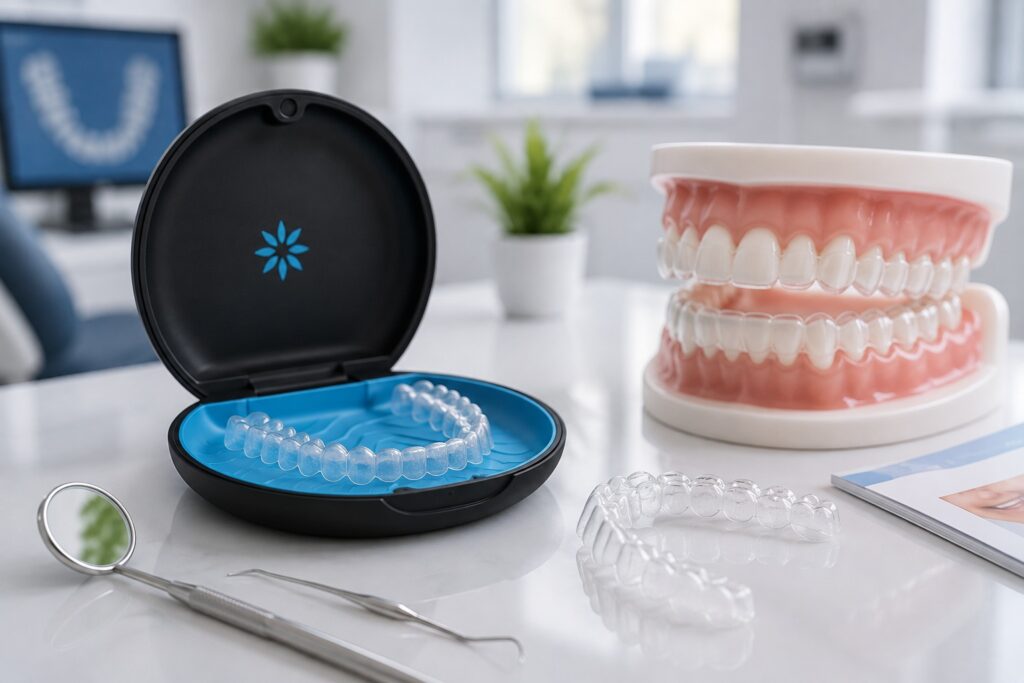
Invisalign, an alternative to traditional braces, is a modern orthodontic treatment that straightens your teeth with clear, removable aligners. In order to gradually shift teeth into the ideal position, the custom-made aligners are designed to fit precisely over your teeth.
Invisalign treatment is for people who want to straighten their teeth without the hassle of any uncomfortable traditional braces. The BPA-free, delicate, smooth, and almost clear plastic is used to make Invisalign aligners. In contrast to traditional braces, Invisalign aligners can easily be removed while eating, flossing, and brushing, making it easier to maintain good oral hygiene. It is considered to be one of the safest and most effective options for straightening your teeth and improving your smile,
Is Invisalign Actually as Effective as Traditional Braces?
For most patients in the UK, yes. Invisalign has come a long way over the years, and for mild to moderate cases, it now gives results just as good as fixed braces.
Where Invisalign really stands out is how easy it is to stick with. Because the trays are removable and nearly invisible, patients find it much easier to stay committed to treatment from start to finish, rather than losing motivation halfway through. This matters because even the best treatment in the world only works if it’s actually worn as prescribed.
There’s nothing wrong with traditional braces, and for certain complex cases they’re still the more predictable choice. But not every dentist offering aligners has the training to handle anything beyond straightforward crowding or spacing.
Dr Nick Dhaliwal treats a genuinely broad range of cases using Invisalign Comprehensive, a system built specifically for more involved corrections that basic aligner treatments simply aren’t equipped to manage.
Which Dental Issues Can Invisalign Actually Correct?
Invisalign treatment is not only about cosmetic tweaks, but it can also address bite and alignment problems, including:
- Overbite. This is one of the most frequently treated cases. The upper front teeth are located too far over the lower arch, and if it’s left untreated for years, it tends to show up later as uneven wear or jaw strain. Invisalign shifts the arches back into a healthier relationship, sometimes with the help of elastics for deeper cases.
- Spacing. Gaps between teeth are usually down to one of three things: a tooth that’s naturally smaller than the arch it sits in, a missing tooth, or simply how the teeth came through. Aligners fill the gap gradually and, because the movement is planned digitally from the outset, the end result is predictable.
- Underbite. Here the lower jaw is more forward than the upper. Whether Invisalign is suitable depends largely on the cause like dental (tooth position) or skeletal (jaw size), and that distinction only becomes clear after an assessment.
- Crossbite. The upper and lower teeth don’t meet correctly on closing, either on one side or both. Left uncorrected, it’s a common cause of chipped enamel and, over the years, gum recession on the affected side.
- Open bite. The front teeth never make contact even with the jaw fully closed, often the legacy of a childhood thumb-sucking or tongue-thrust habit. It makes biting into food harder than most people realise.
- Crowding. When the arch simply hasn’t got space for every tooth to fit properly, Invisalign creates space through controlled movement, which in mild to moderate cases avoids extraction altogether.
Step-by-step guide to the Invisalign treatment process
If you are planning on getting Invisalign braces, it’s worth knowing what actually happens once you’re in a clinic for treatment.
- Consultation: It all starts with a visit to your dentist, who examines your teeth and works out whether Invisalign is genuinely a good fit for what you need.
- Plan of treatment: Once you are cleared as a candidate, your dentist puts together a full treatment plan, built around a 3D image of your teeth and a stage-by-stage map of how they’ll move.
- Fitting an aligner: With the plan finalised, your provider creates your custom aligners. You’ll wear each set for roughly two weeks before moving on to the next one in the series.
- Check-ups: You’ll see your doctor regularly throughout treatment so they can confirm your teeth are tracking the plan and make adjustments if anything needs tweaking.
- Completion: Once the plan runs its course, you’ll be fitted with a retainer to hold your teeth in their new position, so all that progress doesn’t slip backwards.
How Long Should You Expect Treatment to Take?
The Invisalign treatment durations depend on individual requirements. But many patients may see results in 6 to 24 months(totally dependent on case complexity).
For mild cases, Invisalign starts working in as little as 6 months, whereas complex cases may take over a year. Remember, consistency and patience are always key to success. Therefore, wearing your aligners as instructed by your practitioner ensures more efficient and faster results.
Dentists usually recommend keeping them in for 20-22 hours a day; that’s what keeps your teeth moving along as planned.
Take them out too often, or don’t wear them long enough, and treatment can end up dragging on far longer than it should. You might even need extra aligners further down the line just to make up for lost time.
How Much Does Invisalign Actually Cost?
It varies and depends on your smile and how long your treatment plan runs for.
It also differs from practice to practice, largely down to the dentist’s own training and experience with the system. That is why it matters who you choose. You want a team who can actually deliver the result, not just fit you with a generic set of trays.
The average cost of Invisalign across the UK sits somewhere between £1,500 and £5,500.
For an adult treating both the top and bottom arches, aiming for results within 12 to 18 months, you are typically looking at somewhere close to £5,000 for the full treatment.
Why Choose The Dental Surgery Burnham for Your Invisalign Treatment?
Choosing where to have Invisalign treatment matters just as much as choosing the treatment itself, and that’s where
The Dental Surgery Burnham stands apart. Dr Nick Dhaliwal, who trains newly qualified dentists within the Oxford Deanery, brings years of postgraduate study to every case that comes through the door, from simple cosmetic corrections through to full Invisalign Comprehensive plans.
Patients consistently describe feeling genuinely listened to, involved in decisions, and never rushed through their journey to a straighter smile. If you’re considering Invisalign in Burnham, book a consultation and discover a treatment plan built entirely around your needs.
FAQs
How Long Do I Have to Wear Invisalign Each Day?
Invisalign is recommended to be worn all the time except for when you need to eat or brush your teeth. If you’re a bit nervous about feeling uncomfortable sleeping while wearing Invisalign, don’t worry, as they are custom-made for your teeth; they will perfectly fit, and you will feel comfortable.
Do I Need to Clean My Invisalign Aligners? If so, how?
Yes, of course you will need to clean aligners frequently. The simplest way is to rinse them in lukewarm water and brush them with your toothbrush every night.
Is Invisalign Treatment Painful?
Some people may experience minor discomfort for the first few days, but it will pass after a few days as your teeth will adjust to the shape of an aligner.
How long does Invisalign last?
More accurately, there is no forever. But the important thing is that Invisalign is used to help keep your teeth straight and stable. Otherwise, you may risk relapse, i.e. your teeth have shifted after you’ve completed your treatment
Where Can I Get Invisalign?
Our practice is certified and can help you achieve your new Invisalign smile!